
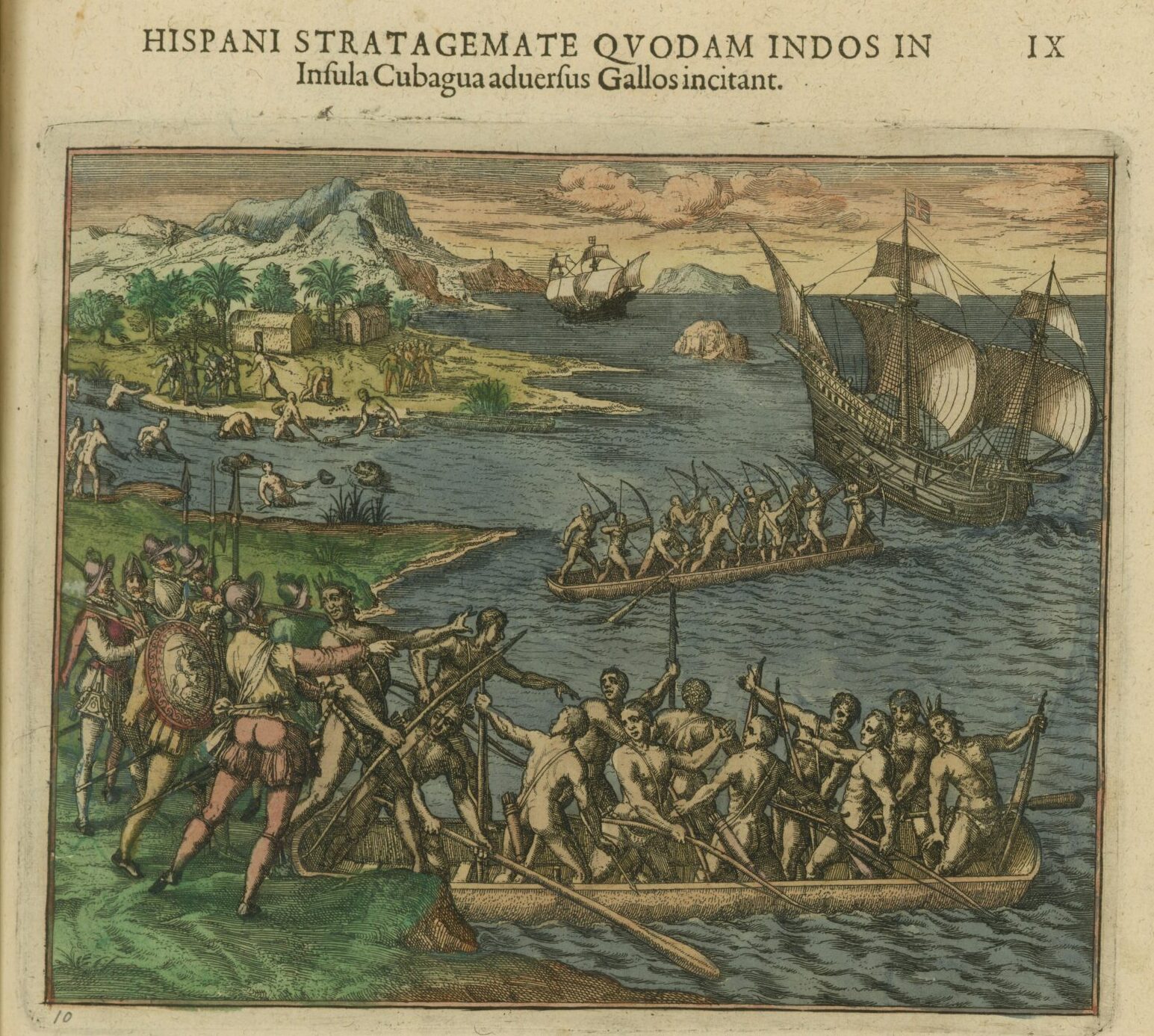
Interview with Fidel Rodríguez Velásquez, author of “Isabel and Orocomay: Indigenous Sovereignty and the Politics of Territorial Control in the Sixteenth-Century Caribbean”

Fidel Rodríguez Velásquez is a permanent researcher at the Centro de Investigaciones Históricas Antropológicas y Culturales (CIHAC-AIP) in Panama City. He is the recipient of the Lewis Hanke Postdoctoral Prize (2025), awarded by the Conference on Latin American History, and the Clara E. Lida Prize (2024), awarded by the Asociación Latinoamericana e Ibérica de Historia Social for the best doctoral dissertation in Latin American social history. You can read his article “Isabel and Orocomay: Indigenous Sovereignty and the Politics of Territorial Control in the Sixteenth-Century Caribbean” in HAHR 106.1.
Interview by Sofía Yazpik
1. How does this work challenge previous historiographies on pearl fisheries in the Americas during the sixteenth century?
I began from a historiography of pearl fishing long shaped by a colonial optic. Scholars have focused on Nueva Cádiz, the settlement on Cubagua Island, and on Iberian actors, acknowledging Indigenous power only in passing rather than treating it as explanatory. Enrique Otte established the documentary foundation for Cubagua; Molly Warsh formulated a political ecology of the imperial pearl trade. Each opened important ground, but Indigenous polities remained context rather than cause.
Cubagua is where that framing breaks down. The location of the fisheries on Cubagua, a barren island with no fresh water, no arable land, no resources of its own, has traditionally been explained by proximity to rich oyster beds. But oyster beds existed throughout the region. Cubagua was where the Iberians ended up because they repeatedly failed to establish themselves on the fertile mainland coast and neighboring islands. The fisheries were not a colonial choice. The pearl economy cannot be understood without centering Indigenous political and military agency: that is the difference this article proposes.
2. What past or current works have most influenced your research?
I approached this project through a set of works that changed how I read both history and anthropology. The Venezuelan anthropologist Miguel Acosta Saignes was foundational: His insistence that there is no anthropology without history and no history without anthropology shaped how I read the past. My professor Rodrigo Navarrete Sánchez, whose work on the Indigenous peoples of eastern Venezuela showed what that commitment looked like in practice, brought that tradition into the classroom and the field.
The encounter with Brazilian historiography deepened and redirected that formation. My time at the Laboratório de Pesquisa em Conexões Atlânticas at PUC-Rio placed me in a scholarly environment where reading colonial archives against the grain was not a methodological option but a disciplinary obligation. It was there that I came to Silvia Hunold Lara’s work on colonial Brazil. Her reading of Palmares not as a story of resistance and suppression but as one of political negotiation between powers that recognized each other showed me that colonial documents carry the traces of worlds that colonial authorities could document but never fully control. That lesson stayed with me across every archive I opened for this article.
Together, these three readings made it possible to move beyond Cubagua. The island had been the anchor of all previous historiography on the pearl fisheries. But to understand why Cubagua existed, and why it eventually ceased to exist, I had to look outward: to the mainland coast, to Margarita Island, to the political worlds that sustained and ultimately withdrew from the pearl economy.
3. How does centering Indigenous political actors’ agency and voices contribute to the history of the Atlantic pearl economy?
I began by trying to fill what looked like a gap in the history of the pearl economy, but it quickly became clear that centering Indigenous political agency does something else entirely: It changes the story. When Isabel and Orocomay are treated as protagonists rather than backdrop, what emerges is a Caribbean in which Iberian colonial power was neither inevitable nor dominant, a region where European presence was conditional, intermittent, and dependent on Indigenous approval. This is what John Monteiro pointed out decades ago for Brazilian history: Recovering Indigenous actors does not add a chapter to the existing narrative; it rewrites the narrative entirely. Isabel’s decision to send her archers against the French in 1528 was not an act of collaboration with a dominant power; it was a sovereign political calculation by a leader who controlled the terms of Iberian presence on Margarita Island. Orocomay’s refusal to trade with Cubagua after the pearl fishers captured her grandson was not resistance, it was governance. Read this way, colonial documents stop being straightforward statements of imperial intent and become records of decisions made elsewhere, decisions officials were trying and often failing to manage. Chronicles, residencias, and judicial records no longer only tell us what colonial authorities wanted; they show us what they were up against. This shift in reading the archive matters well beyond the pearl economy: it changes how we understand the early modern Caribbean as a whole.
4. To what extent has gender studies influenced your work on Isabel and Orocomay, and how does this approach influence how you tell their stories?
Gender studies has shaped this work through a specific methodological commitment: writing about women as political actors with particular histories rather than as representatives of a group or a culture. Lila Abu-Lughod’s “Writing Against Culture,” itself a feminist intervention against the ways anthropology had systematically excluded women’s perspectives, gave me the clearest formulation of that commitment. Her call for an “ethnography of the particular” resonated with the intellectual environment I found at the Laboratório at PUC-Rio, where Crislayne Alfagali’s work on African history kept reminding us that political hierarchies and women’s leadership look very different once European frameworks are set aside.
Jalil Sued Badillo’s work on Indigenous women in the Caribbean antillano was an early alert: Cacicas had been there all along, waiting for historians willing to take their political authority seriously. That methodological choice reordered the writing as well: Isabel and Orocomay appear with name and dated decisions, not as illustrations of a generic female agency.
5. Does this study form part of a larger research project you plan on pursuing in the future?
I see this article as one piece of a larger book on how pearls, whether as commodity, symbol, or object of coercion, offer a window into the ways Indigenous and African peoples shaped the early modern world. The pearl is not the story; it is the thread that pulls together histories of labor, sovereignty, political negotiation, and global connection that have too often been told from the perspective of those who profited from them. Following that thread has meant moving between archives on both sides of the Atlantic, reading the archive for the worlds it was trying to govern rather than only the policies it was trying to impose, and listening to what the sources reveal.
My new position at the Centro de Investigaciones Históricas, Antropológicas y Culturales (CIHAC-AIP), a recently established research center in Panama City dedicated to interdisciplinary work in history, archaeology, and anthropology founded by the historian Marixa Lasso and currently directed by the archaeologist Juan Guillermo Martín, has opened a dimension of this research. At CIHAC, these fields converge in the study of Panama’s deep past and its place within the circum-Caribbean. Panama’s position at the juncture of two oceans has fundamentally reshaped how I approach the geography of this project. What began as an Atlantic history is now becoming something larger: a history of how pearls connected labor regimes, Indigenous political worlds, and global commodity circuits across both the Atlantic and the Pacific.
There is also a dimension of this project that moves into the present. Together with my colleague Oliver Antczak, I co-lead Gente de Mar, a project on how the histories of maritime peoples, Indigenous communities whose lives were shaped by the sea, by pearl fishing, by coerced labor, are remembered, recovered, and contested as heritage today. The past and the present turn out to be less separate than the archive sometimes suggests.
6. Read anything good recently?
Two recent books have stayed with me.
Bethany Aram’s Anchoring an Empire integrates archival documentation, archaeology, and genetics to reconstruct the lives of Indigenous, African, and European people across the sixteenth- and seventeenth-century Isthmus of Panama, lives that no single source type could reach. That combination is not decorative: It is what allows her to recover trajectories that elude any one archive. Reading her now that I am based in Panama City carries a different weight: The isthmus that she reconstructs from the archives is the same ground that I walk every day, and the questions that she asks about how ordinary people sustained an empire at the crossroads of two oceans feel especially urgent for the research that I am now pursuing. The isthmian world that she reconstructs is precisely the one I am beginning to explore from a different angle, following pearls and the people bound to them across the same geography. Her methodological ambition sets a standard for what that exploration can become.
Jorge Cañizares-Esguerra and Adrian Masters’s The Radical Spanish Empire is the other. Their argument is that the Spanish crown did not so much conquer the Indies as dialogue incessantly with its vassals. The monarchical power that emerged by the 1570s was not designed from above but forced upward by decades of what they call lawfare: petitions, residencias, and litigation through which Indigenous, African, and plebeian subjects dismantled conquistadors, friars, and caciques one by one. It is one of those interventions that forces you to reconsider not just a field but a set of assumptions so embedded that they had ceased to register. Petitions, residencias, judicial records, the documents we tend to read as records of colonial power, turn out, when read carefully, to be records of the people who navigated, challenged, and sometimes bent that power to their own ends as well. It is a book that makes you return to your own archives with different eyes.
Reading both books in the months of my arrival in Panama has set the terms for the next stage of this research.